

Choosing the right AI-powered website solution for your small business is genuinely difficult. The market is full of promises, but very few providers show you real numbers, honest trade-offs, or evidence that their tools actually work in practice. If you're a UK small business owner trying to make a smart decision, you need more than a sales pitch. You need selection criteria, real-world case studies, and a clear comparison of your options so you can invest with confidence.
Table of Contents
- How to evaluate AI-powered websites for your business
- AI chatbots in action: UK SMEs cutting costs
- AI assistants enhancing online shopping experiences
- Comparison: Pure AI vs. hybrid chat solutions
- What most guides miss: The hidden costs and real gains of AI websites
- How Livett Web Designs delivers custom AI websites
- Frequently asked questions
Key Takeaways
| Point | Details |
|---|---|
| Evidence-based approach | Use real business data when choosing AI-powered web solutions to maximise ROI. |
| Hybrid chat wins | Hybrid chat models offer better value for both customer satisfaction and operational cost savings. |
| Automation boosts sales | AI assistants can dramatically increase sales and efficiency by automating processes and responses. |
| UK-specific insights | Case studies from UK SMEs prove significant savings and customer experience improvements. |
| Customisation is key | Tailoring AI features to your business needs ensures optimal outcomes and client satisfaction. |
How to evaluate AI-powered websites for your business
Before you look at any specific tool or platform, you need a clear framework for evaluation. Without one, it's easy to get dazzled by features that sound impressive but don't actually move the needle for your business.
Here are the key criteria worth applying to any AI-powered website solution:
- Cost and return on investment: What does it cost to set up, maintain, and scale? Are there hidden fees for integrations or support?
- Scalability: Can the solution grow with your business without requiring a complete rebuild?
- Ease of integration: Does it connect cleanly with your existing tools, such as your CRM, booking system, or inventory software?
- Customer experience impact: Does it genuinely improve the journey for your customers, or does it just automate in ways that frustrate people?
- Data security: Especially relevant for UK businesses operating under UK GDPR, where data handling is a legal responsibility, not just a preference.
One of the most common mistakes small business owners make is assuming that more automation always means more savings. That's not always true. UK SMEs using AI chatbots for customer service saved over £50,000 annually in staffing costs by handling 70% of queries, and another reduced document review time by 60%, saving £50,000 yearly. Those are real, measurable results. But they came from well-implemented, hybrid solutions, not from simply switching on a chatbot and hoping for the best.
Another common mistake is misinterpreting ROI. Some businesses count only the direct cost savings and ignore the indirect costs, such as the time spent managing a poorly configured AI tool, or the customer satisfaction dip that comes from a chatbot that can't handle nuanced queries.
"The businesses that get the most from AI-powered websites are the ones that treat the technology as a support layer, not a replacement for genuine customer relationships."
Pro Tip: Before committing to any AI-powered website solution, ask the provider for real-world performance data from businesses similar to yours in size and sector. If they can't provide it, that tells you something important.
You can explore AI website examples that demonstrate practical, business-critical tools built with genuine AI integration, not just templated add-ons.
AI chatbots in action: UK SMEs cutting costs
Now that you know the key evaluation points, it's worth seeing how chatbots deliver measurable savings in practice. The numbers are compelling, but the context matters just as much as the figures.
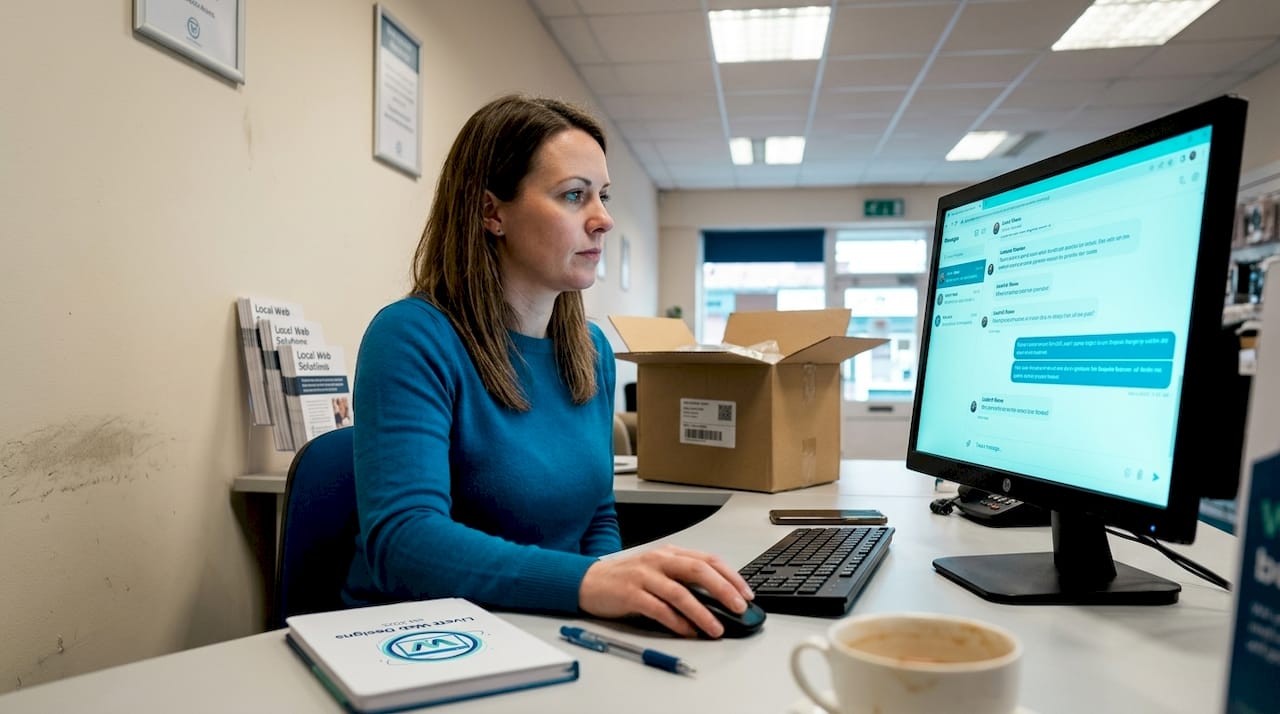
UK small businesses have been quietly adopting AI chatbots for customer service over the past few years, and the results are becoming clearer. The savings aren't theoretical. According to published data, staffing cost savings of over £50,000 per year are achievable when chatbots handle the majority of routine customer queries, freeing up staff to focus on higher-value work.
Here's what well-implemented AI chatbots typically deliver for UK SMEs:
- Query handling at scale: A chatbot can manage hundreds of simultaneous conversations without any increase in staffing cost. For businesses that experience seasonal spikes, this is particularly valuable.
- Document automation: Automating document review and data entry reduces human error and frees up significant staff time. One UK SME reduced document review time by 60%, a saving that compounded across the year.
- 24/7 availability: Customers expect answers outside of business hours. A chatbot doesn't clock off at 5pm, which directly improves customer satisfaction scores.
- Consistent messaging: Unlike human agents who may give slightly different answers on different days, a well-configured chatbot delivers consistent, accurate information every time.
Here's a summary of the kind of results UK SMEs have reported:
| Business type | AI application | Annual saving | Efficiency gain |
|---|---|---|---|
| Customer service SME | AI chatbot (70% query handling) | £50,000+ in staffing | 70% query automation |
| Professional services firm | Document review automation | £50,000+ yearly | 60% time reduction |
| E-commerce retailer | AI product recommendations | Increased conversion | Reduced support load |
The critical insight here is that the businesses achieving these results didn't simply install an off-the-shelf chatbot. They invested time in configuring the tool properly, training it on their specific products and services, and building in a clear handoff process for queries that required human attention. That last point is what separates a chatbot that saves money from one that damages your reputation.
"Hybrid solutions, where AI handles the routine and humans handle the complex, consistently outperform purely automated approaches in both customer satisfaction and long-term ROI."
Improving operational efficiency with AI is genuinely achievable for small businesses, but it requires the right build, not just the right technology.
AI assistants enhancing online shopping experiences
Beyond chatbots, AI assistants are transforming e-commerce and service websites in ways that go well beyond answering questions. They're influencing purchasing decisions, reducing response times, and creating personalised experiences at a scale that would be impossible with human staff alone.
The evidence is striking. Macy's AI shopping assistant boosted revenue per visit by 4.75 times for users compared to non-users. That's not a marginal improvement. It's the kind of uplift that fundamentally changes the economics of running an online store. The assistant guided customers through product discovery, answered questions in real time, and reduced the friction that typically causes people to abandon a purchase.
On the customer service side, Simplyhealth reduced email response time from 12 minutes to 1 minute using Salesforce Einstein. For a business handling thousands of customer enquiries, that's a transformative change in operational capacity.
Here's a comparison of the impact across these two examples:
| Organisation | AI tool | Key metric before | Key metric after |
|---|---|---|---|
| Macy's | AI shopping assistant | Baseline revenue per visit | 4.75x revenue per visit for AI users |
| Simplyhealth | Salesforce Einstein | 12-minute email response | 1-minute email response |
The features driving these results tend to follow a pattern. Here's what the most effective AI assistants on e-commerce and service websites typically include:
- Real-time product or service recommendations based on browsing behaviour and stated preferences.
- Natural language query handling so customers can ask questions in plain English and get accurate, relevant answers.
- Automated follow-up messaging that keeps customers engaged without requiring manual intervention from your team.
- Personalised content delivery that adjusts what a customer sees based on their history and behaviour on your site.
- Seamless escalation to human agents when the AI reaches the limits of what it can handle confidently.
Pro Tip: Prioritise AI tools that automate responses and scale with your growth. A solution that works well for 100 customers a month should work just as well for 1,000, without you having to rebuild it from scratch.
Understanding the benefits of AI assistants in a practical, small business context is key to making the right investment decision.
Comparison: Pure AI vs. hybrid chat solutions
To clarify which approach works best, here's a practical comparison for decision-making. This is one of the most important choices you'll make when adopting AI for your website, and it's one that many guides gloss over.
| Feature | Pure AI chatbot | Live chat (human only) | Hybrid (AI + human) |
|---|---|---|---|
| Cost | Low ongoing cost | High staffing cost | Moderate, scalable cost |
| Availability | 24/7 | Business hours only | 24/7 with human backup |
| Customer satisfaction (CSAT) | 67 to 75% | High, context-dependent | High, consistently |
| Handling complex queries | Poor | Excellent | Excellent |
| Scalability | Very high | Limited by headcount | High |
| Best for | FAQs, simple tasks | Nuanced, high-value queries | Most SME use cases |
The data is clear on this. Pure AI risks customer frustration on complex queries, with CSAT scores typically ranging from 67 to 75%, while live chat scores higher on nuance but carries a significantly higher cost. Hybrid solutions achieve the best ROI for small operations by combining the efficiency of automation with the reassurance of human support when it's genuinely needed.
Here's a practical guide to which solution fits which scenario:
- Pure AI is suitable when your customer queries are largely repetitive, your budget is tight, and you have a well-defined FAQ that covers 80% of what people ask.
- Live chat is suitable when your customers are making high-value decisions, your queries are complex and varied, and you have the staff capacity to manage it consistently.
- Hybrid is suitable for most UK SMEs because it gives you the cost efficiency of automation for routine queries while ensuring customers with complex needs aren't left frustrated by a bot that can't help them.
"The businesses that invest in hybrid chat solutions see stronger long-term returns precisely because they don't sacrifice customer experience for the sake of cutting costs. The two aren't mutually exclusive."
Exploring hybrid chat solution benefits in the context of your specific business model is a sensible next step before making any investment.
What most guides miss: The hidden costs and real gains of AI websites
Here's an honest perspective you won't find in most mainstream guides on AI websites. The conversation tends to focus almost entirely on what AI can save you. The hidden costs rarely get the same attention, and that's a problem.
The first hidden cost is configuration time. A chatbot that isn't properly trained on your products, services, and tone of voice will frustrate your customers. Fixing that after launch is more expensive than getting it right at the start. Many small businesses underestimate how much time and knowledge goes into building an AI tool that genuinely reflects their business.
The second hidden cost is customer satisfaction erosion. If your AI handles 70% of queries but handles them badly, you haven't saved money. You've damaged your reputation. A customer who gets a useless automated response doesn't just leave. They often don't come back. The CSAT data on pure AI solutions, sitting between 67 and 75%, tells you that roughly one in three customers isn't satisfied. For a small business where every customer relationship matters, that's a significant risk.
The third hidden cost is the false economy of cheap templates. Many AI website tools are built on generic templates with AI features bolted on. They look impressive in a demo but they don't integrate cleanly with your existing systems, they don't scale well, and they don't reflect the specific logic of your business. You end up paying to fix problems that a properly built, custom solution would never have created.
The real gains come when you treat AI as a layer of intelligence built into a custom system, not as a product you install. Businesses that approach it this way see genuine, sustained improvements in efficiency, customer experience, and revenue. The ones that buy a template and hope for the best tend to be disappointed within six months.
The uncomfortable truth is that AI-powered websites require genuine investment in the build phase. But when that investment is made properly, the returns are real and measurable, as the case studies in this article clearly show.
How Livett Web Designs delivers custom AI websites
The examples and data in this article make one thing clear: the difference between AI that works and AI that wastes money comes down to how it's built and how well it fits your specific business.
At Livett Web Designs, we build custom AI website solutions from the ground up using proprietary AI software, not templates. Every project follows a structured four-phase process: understanding your requirements, designing the logic, AI-powered generation, and deployment. That means your solution is built around how your business actually works, not around how a generic platform thinks it should work. Whether you need a chatbot that handles customer queries, an inventory management tool, or a fully integrated web application, we build it to your specification, with transparent pricing and direct communication throughout. No agency overheads. No guesswork. Just practical, business-critical tools that deliver real results.
Frequently asked questions
How much can UK SMEs save with AI chatbots?
UK SMEs can save over £50,000 annually in staffing costs by allowing AI chatbots to handle 70% of customer queries, with additional savings available through document automation.
What is the main benefit of hybrid chat solutions over pure AI?
Hybrid chat solutions balance automation and human support, achieving higher ROI and customer satisfaction than pure AI alone, particularly for small business operations where complex queries are common.
How do AI website assistants improve e-commerce sites?
AI-powered assistants dramatically increase revenue per visit and reduce response times. Macy's AI assistant boosted revenue per visit by 4.75 times, while Simplyhealth cut response times from 12 minutes to just 1 minute using Salesforce Einstein.
Can AI-powered websites be customised for small business needs?
Yes, AI websites can be tailored to your specific business operations and customer journeys, ensuring the solution fits your unique requirements rather than forcing your business to adapt to a generic template.