

Most small business owners assume that once a website goes live, the job is done. That's a costly misconception. True digital growth doesn't stop at launch. It depends on a joined-up process that covers everything from the first conversation about your requirements right through to ongoing improvements, security updates, and performance monitoring. As AI tools become more capable and customer expectations rise, UK small businesses that rely on fragmented, piecemeal development are already falling behind those who've adopted fully integrated, end-to-end approaches.
Table of Contents
- Defining end-to-end web development
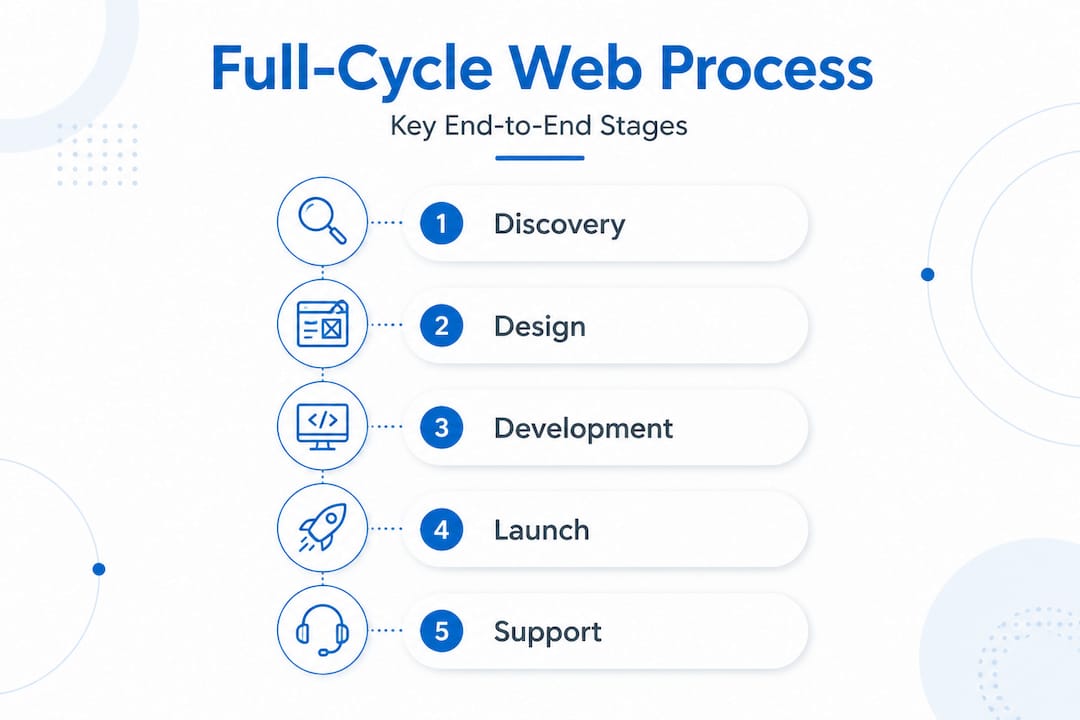
- The anatomy of a full-cycle development process
- Agile methods and AI: Accelerating results
- How end-to-end web development delivers concrete business value
- Why single-team accountability is the hidden driver of digital growth
- Take the next step with tailored end-to-end solutions
- Frequently asked questions
Key Takeaways
| Point | Details |
|---|---|
| All-in-one lifecycle approach | End-to-end web development means every stage, from planning to maintenance, is handled by a single, accountable team. |
| Agile and AI boost efficiency | Modern techniques like Agile practices and AI automations deliver faster, more reliable results for small businesses. |
| Single-team accountability drives growth | Working with one provider ensures fewer errors, rapid updates, and long-term digital success. |
| Custom solutions for UK SMEs | End-to-end processes adapt to your unique needs, helping you stay ahead in a competitive market. |
Defining end-to-end web development
With the misconception addressed, it's critical to understand exactly what "end-to-end web development" actually means in practice.
End-to-end web development is a comprehensive approach where a single team or partner manages the entire software development lifecycle, from initial concept, discovery, design, development, testing, deployment, to ongoing maintenance and support. That's a significant shift from the traditional model, where you might hire one person to design a site, another to build it, and a third to maintain it.
For UK small businesses, this matters enormously. When different vendors handle different parts of your digital presence, things fall through the gaps. A designer hands over files to a developer who wasn't involved in the brief. A developer deploys code that the maintenance team doesn't fully understand. Each handoff creates risk.
Here's what a genuine end-to-end approach covers:
- Discovery and requirements gathering: Understanding your business goals, your users, and your technical constraints before a single line of code is written
- UX and interface design: Creating logical, user-friendly layouts that reflect your brand and guide visitors toward action
- Front-end and back-end development: Building both what users see and the systems that power it, from databases to APIs
- Testing and quality assurance: Checking that everything works correctly across devices, browsers, and user scenarios
- Deployment and launch: Getting your solution live securely and efficiently, with minimal disruption
- Ongoing maintenance and support: Keeping your site or application updated, secure, and performing well over time
"End-to-end web development reduces risk precisely because there are no handoffs between teams who don't share context. One team owns the outcome from start to finish."
When you work with AI-driven web solutions built around this model, you're not just getting a website. You're getting a digital tool that was designed with your specific operational needs in mind, and that continues to evolve as your business does.
The anatomy of a full-cycle development process
Now that the core concept is clear, let's break down the key stages in a truly end-to-end project and why each one matters.
A well-run end-to-end development project typically follows a structured sequence. Here's how it looks in practice:
- Requirements and discovery: This is where the real work begins. A good developer asks detailed questions about your business processes, your customers, and the problems you're trying to solve. Skipping this stage is one of the most common reasons projects fail.
- Logic design and architecture: Before any code is written, the system's logic is mapped out. How will data flow? What user roles are needed? What integrations are required? Getting this right early prevents expensive rework later.
- AI-powered development and generation: Using modern AI tools, experienced developers can build functional, secure, and scalable solutions significantly faster than traditional methods allow. This isn't about cutting corners. It's about using intelligent automation to handle repetitive tasks so that more time is spent on the parts that genuinely require human judgement.
- Testing and iteration: Every feature is tested against real-world scenarios. This includes functional testing, security checks, and performance benchmarking. Issues are caught and fixed before they reach your users.
- Deployment: The solution is launched in a controlled, secure manner. This includes configuring hosting environments, setting up SSL certificates, and ensuring data is protected from day one.
- Support and ongoing development: Post-launch support means your solution continues to work as your business grows. Updates, new features, and security patches are handled by the same team that built the product.
| Stage | Key activity | Business benefit |
|---|---|---|
| Discovery | Requirements gathering | Avoids costly misunderstandings |
| Design | Logic and UX planning | Reduces rework and confusion |
| Development | AI-assisted build | Faster delivery, lower cost |
| Testing | QA and security checks | Fewer bugs, better reliability |
| Deployment | Secure launch | Smooth go-live with no downtime |
| Support | Ongoing maintenance | Long-term performance and security |
Pro Tip: Before engaging any developer or agency, ask them directly: "Who will be responsible for this project after launch?" If the answer is vague or involves a separate support team, that's a warning sign. Continuity of ownership is what makes end-to-end development genuinely valuable.
The full-cycle approach isn't just about having more stages. It's about those stages being managed by people who share context, communicate directly, and are accountable for the whole outcome, not just their slice of it.
Agile methods and AI: Accelerating results
With the stages outlined, the question becomes: how can you make development cycles faster, smarter, and less risky? Enter Agile approaches and AI.
Traditional web development often worked in long, rigid phases. You'd agree a specification, wait weeks for a prototype, review it, request changes, and wait again. For small businesses operating in fast-moving markets, that pace is simply too slow.
Agile practices like Scrum or Kanban for iterative development, combined with DevOps integration and CI/CD pipelines, enable rapid iteration and reduce handoffs between teams. In plain terms, this means your project moves in short, focused cycles. You see working software sooner. You can give feedback earlier. And changes cost far less to implement because they're caught before they become deeply embedded in the codebase.
Here's a practical comparison:
| Factor | Traditional approach | Agile and AI approach |
|---|---|---|
| Delivery timeline | Months before first review | Working prototype in weeks |
| Feedback cycle | End of project | Every sprint (1 to 2 weeks) |
| Change requests | Expensive and disruptive | Built into the process |
| Risk of failure | High (late discovery of issues) | Low (issues caught early) |
| Cost of errors | Significant rework cost | Minimal, caught in iteration |
For UK small businesses, AI automations and rapid iteration mean you're not locked into a slow, expensive process. You get a working solution faster, and you can adapt it as your needs change, without starting from scratch each time.
Pro Tip: Ask your developer whether they use version control and automated testing. These aren't just technical details. They're the foundation of a reliable, maintainable codebase that won't cause you problems six months after launch.
The efficiency gains from AI-driven development are particularly relevant for small businesses that need single-team accountability and rapid iterations to outpace competitors without the complexity of managing multiple vendors. When one person or team handles everything from brief to deployment, the speed advantage compounds at every stage.
How end-to-end web development delivers concrete business value
The practical impact for business owners starts to take shape when you see the direct link between process improvements and tangible results.
It's easy to talk about "efficiency" and "streamlined operations" in abstract terms. Let's be more specific. Here's what end-to-end development actually looks like in practice for a small UK business.
Consider a logistics company in Essex that was managing vehicle maintenance records using spreadsheets and paper forms. Every time a vehicle needed a service, someone had to manually update a spreadsheet, email the relevant team, and file a paper record. Errors were common. Records went missing. Compliance audits were stressful.
An end-to-end digital solution replaced that entire process with a custom digital logbook. Drivers log maintenance events directly from their phones. Managers receive automatic alerts when a service is due. Audit records are generated instantly. The same team that built the system continues to maintain it, add features, and respond to issues, without the business needing to brief a new developer from scratch each time.
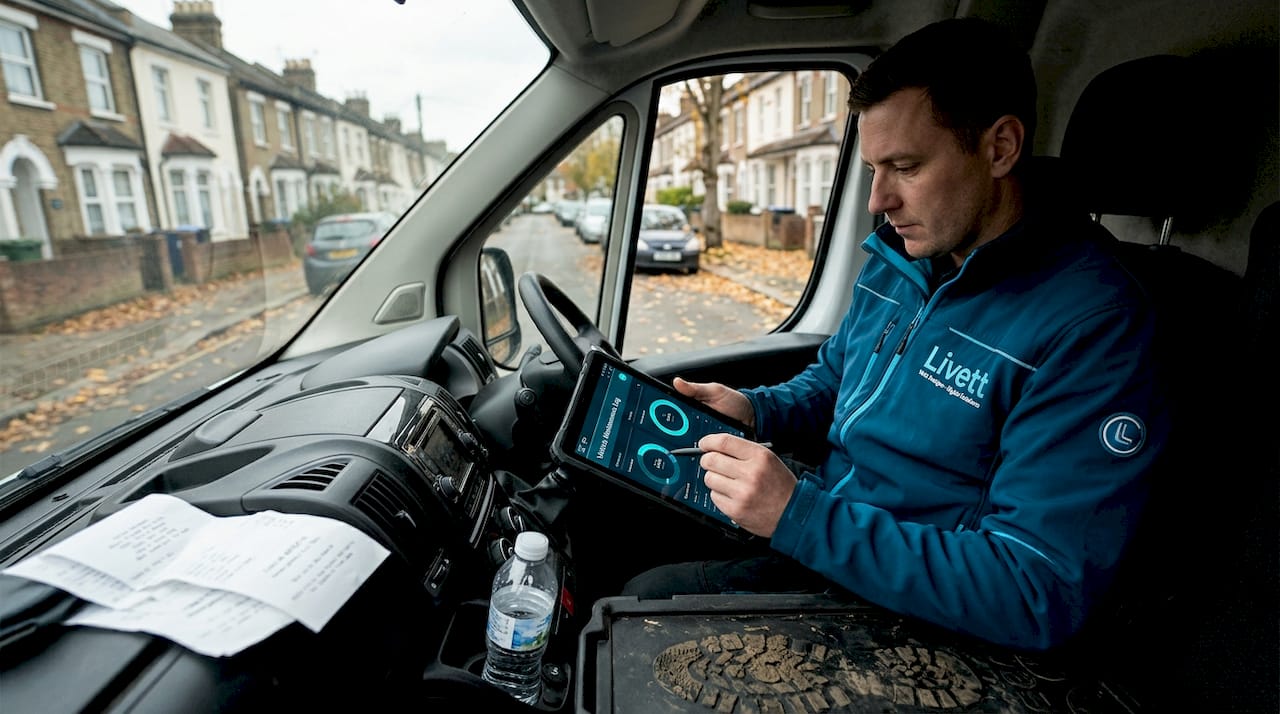
That's the kind of operational value that a well-built, personalised AI-driven web solution can deliver. And it's only possible when the developer understands the business deeply enough to build something genuinely useful.
Here are the core business benefits, stated plainly:
- Fewer errors: When one team owns the whole project, there's no "that's not my responsibility" moment. Problems get caught and fixed by the people who built the system.
- Faster updates: Because the developer knows the codebase inside out, adding a new feature or fixing a bug takes hours rather than days.
- Lower long-term cost: Preventative maintenance and proactive updates are far cheaper than emergency fixes after something breaks in production.
- Better security: Security is built in from the start, not bolted on afterwards. Data is protected at the layer where it matters most.
- Scalability: A well-architected solution grows with your business. You don't need to rebuild from scratch every time your needs change.
"Single-team accountability means there's always someone who genuinely understands your system, your data, and your business goals. That's not a luxury. For a growing small business, it's a necessity."
Single-team ownership is particularly valuable for small businesses that don't have an in-house IT department. You need a partner who can respond quickly, communicate clearly, and take genuine responsibility for the tools your business depends on.
Why single-team accountability is the hidden driver of digital growth
Here's something that doesn't get said often enough: most small business web projects don't fail because of bad technology. They fail because of bad handoffs.
A business hires a designer who produces beautiful mockups. Those mockups go to a developer who wasn't in the original meetings and makes assumptions. The developer hands off to a hosting company that has no idea what the site is supposed to do. Six months later, the business owner is dealing with a site that's slow, hard to update, and doesn't actually solve the original problem.
This pattern is remarkably common. And it's entirely avoidable.
When you work with a single developer or tightly integrated team who owns the project from start to finish, something important shifts. The person building your system is the same person who asked about your business goals at the start. They remember why certain decisions were made. They know where the edge cases are. When something breaks or needs updating, they don't need to spend three hours reading someone else's code before they can help you.
Looking at real-world examples of end-to-end delivery, the businesses that see the most consistent digital growth are those that treat their web developer as a long-term partner rather than a one-off contractor. They invest in a relationship where the developer understands the business deeply, not just the technology.
If you're evaluating end-to-end providers, here are the questions worth asking:
- Will the same person or team handle my project from brief to launch and beyond?
- How do you handle change requests during the build?
- What does ongoing support look like after launch?
- Can I see examples of projects you've maintained over time, not just launched?
- How do you handle security updates and performance monitoring?
The answers will tell you quickly whether you're dealing with a genuine end-to-end partner or a vendor who'll hand you off the moment the site goes live.
Ownership isn't just a process detail. It's the foundation of competitive advantage for small businesses that need their digital tools to work reliably, adapt quickly, and grow alongside them.
Take the next step with tailored end-to-end solutions
Now that you understand the importance and specifics of end-to-end web development, consider how to put these insights to work in your own business.
If you're running a small business in the UK and you're frustrated with slow updates, unreliable vendors, or digital tools that don't quite fit how you work, you're not alone. The good news is that a better approach exists.
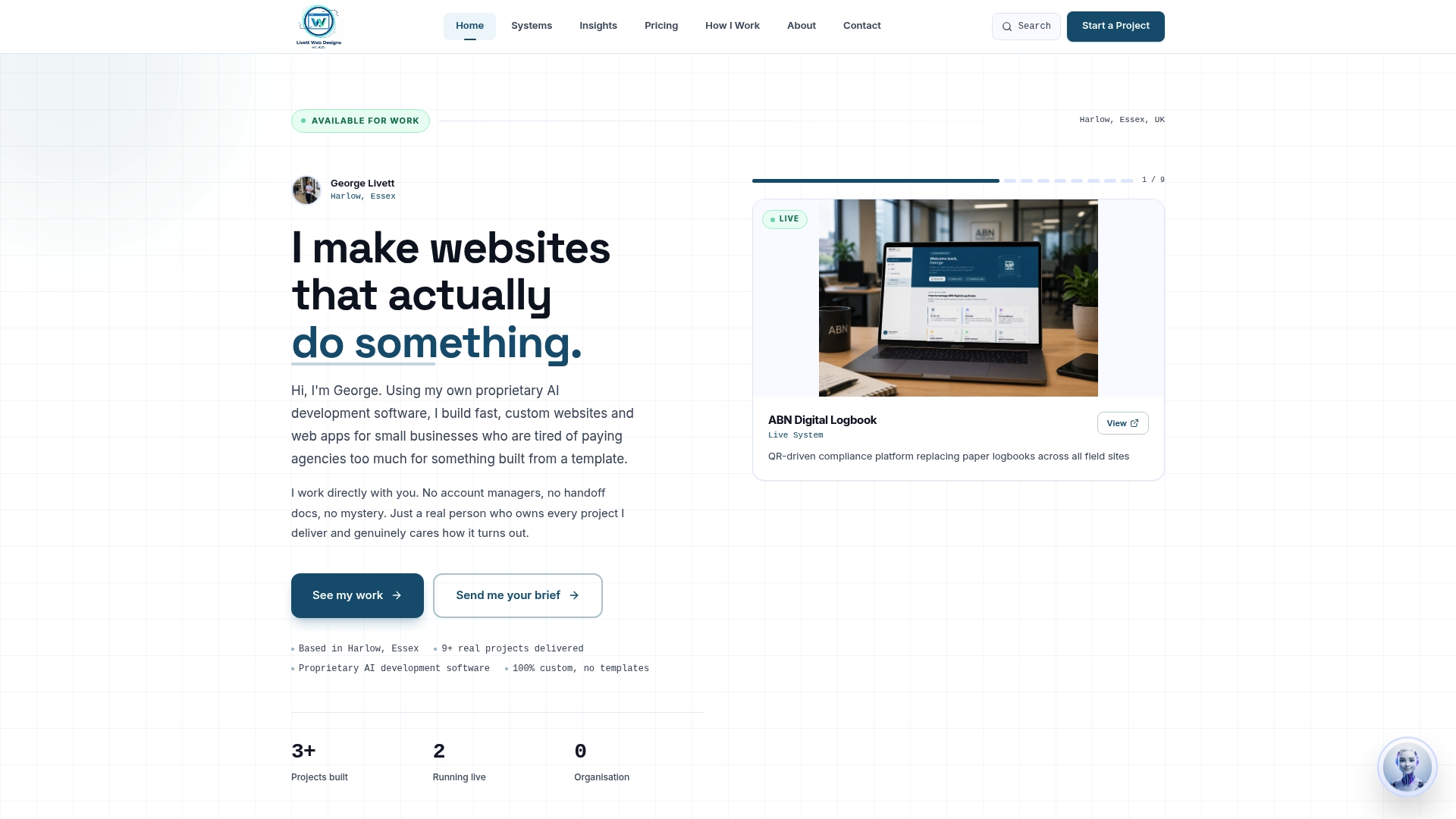
Livett Web Designs offers bespoke, AI-powered end-to-end web development built around your specific business needs. From the first conversation about your requirements through to deployment and ongoing support, you work directly with the developer. No agency overheads. No templates. No handoffs to people who weren't involved in the original brief. Just clear communication, fast delivery, and digital tools that genuinely support how your business operates. If you're ready to explore what a personalised, end-to-end solution could look like for you, get in touch today.
Frequently asked questions
How does end-to-end web development differ from traditional web design?
End-to-end development covers the entire lifecycle including strategy, design, development, launch, and ongoing support, whereas traditional web design typically stops once the site goes live, leaving maintenance and updates as a separate concern.
Why is single-team ownership important for my business website?
Single-team accountability means fewer delays, less miscommunication, and consistent maintenance from people who already understand your system, rather than starting from scratch every time something needs updating.
Can end-to-end web development help me update my site faster?
Yes. Using Agile and CI/CD pipelines, updates and new features can be planned, built, and deployed in short cycles, often within days rather than the weeks or months that traditional approaches typically require.
Is end-to-end web development more expensive than hiring separate vendors?
While upfront costs may be comparable, end-to-end approaches reduce risk and typically lead to long-term savings by eliminating the hidden costs of communication errors, duplicated work, and expensive emergency fixes that fragmented vendor arrangements so often produce.